WHY MAKE IT
A little comfort, a lot of flavor.
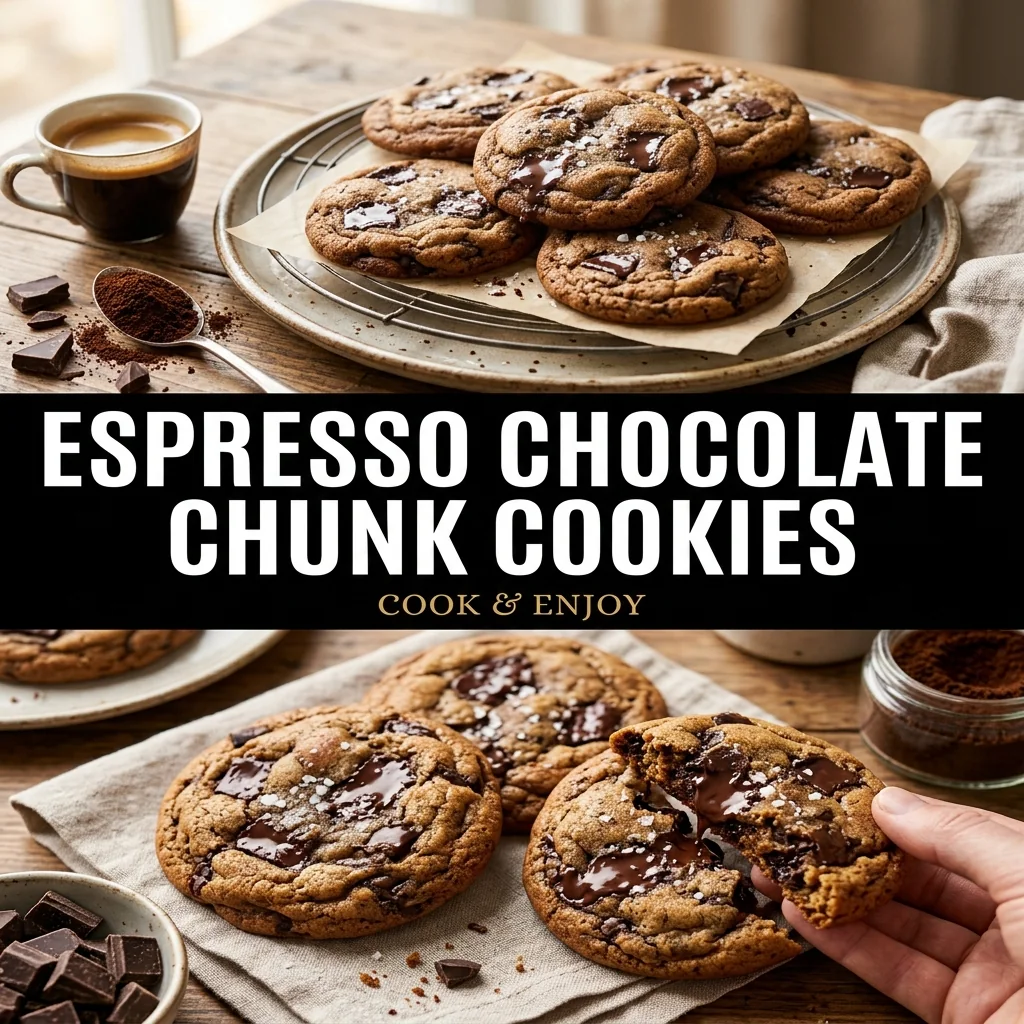
Espresso Chocolate Chunk Cookies bridge the worlds of artisanal pastry and morning coffee house craft. The process begins by browning unsalted butter to create complex toasted milk solids, which provide a rich foundation for dark brown sugar and aromatic espresso powder. Hand-chopped dark chocolate yields diverse sizes of chocolate pockets throughout each cookie, ranging from delicate flakes that melt into the dough to substantial molten pools. Chilling the dough permits the flour starches to fully hydrate and absorb the flavored fats, resulting in thick cookies with crisp, rippled edges and dense, fudgy centers. Finished with crunchy sea salt, they offer a sophisticated balance of bitterness and sweetness.
The Chemistry of Brown Butter and Moisture Loss
Standard butter contains roughly sixteen to eighteen percent water, which evaporates as steam during the browning process. If this moisture loss is not accounted for, cookies can turn out dry or crumbly. Incorporating an extra egg yolk restores essential moisture and provides natural lecithin, which binds the butterfat to the sugars into a stable emulsion. This ensures the finished cookie develops the prized chewy interior and paper-thin, crinkled top crust rather than spreading into a greasy, thin wafer on the baking sheet.
Espresso Powder as a Flavor Enhancer
Instant espresso powder is concentrated, dehydrated brewed coffee that dissolves instantly in warm fats or liquids. Unlike regular ground coffee beans, which remain gritty and unpalatable when baked, espresso powder melts away completely. In small amounts, coffee acts as a background amplifier that enhances chocolate flavor without asserting itself. At the level specified in this recipe, it steps forward into a distinct mocha profile, providing roasted bitterness that counterbalances the rich sugars and heavy cocoa butter.
Why Dough Resting Matters
Baking cookie dough immediately after mixing warm browned butter produces excessive spread, resulting in thin, greasy cookies with greasy rims. Allowing the dough to rest in the refrigerator for forty-five minutes drops the fat temperature back to a semi-solid state. More importantly, this resting window allows wheat proteins and starches to absorb free liquids, enzyme activity to break down complex carbohydrates into simple sugars, and flavor compounds from the espresso and brown butter to meld thoroughly.
Before you start
Browning the butter boils off natural water content, intensifying the fat's rich hazelnut notes and pairing naturally with espresso. Dissolving the espresso powder directly into the warm butter fat ensures uniform dispersion throughout the dough without leaving bitter, grainy specks. Use a block of chocolate chopped by hand with a chef's knife rather than chips alone; the resulting irregular shards melt into broad pools within the cookie crumb.
THE RECIPE
Espresso Chocolate Chunk Cookies
18 servings · 20 minutes preparation · 27 minutes cooking · 75 minutes cooling, chilling or resting
Ingredients
Step-by-step instructions
- Melt the 140 grams of unsalted butter in a light-colored skillet over medium heat, swirling frequently for 4 to 5 minutes until the milk solids foam, turn a nutty golden-brown color, and emit a toasted aroma, then immediately pour into a heatproof bowl and cool for 15 minutes.
- Stir the instant espresso powder into the warm brown butter until evenly dispersed, then let the mixture sit until lukewarm to the touch.
- Add the dark brown sugar and granulated sugar to the brown butter mixture, whisking vigorously by hand for 2 minutes to break down sugar crystals and coat them evenly in fat.
- Whisk in the whole egg, egg yolk, and vanilla extract until the batter transforms into a thick, glossy, ribbon-forming emulsion, about 90 seconds of steady beating.
- In a separate medium bowl, whisk together the all-purpose flour, baking soda, baking powder, and fine sea salt to disperse the leavening agents evenly.
- Pour the dry ingredients into the wet mixture and fold gently with a wooden spoon or silicone spatula until only a few faint streaks of flour remain visible.
- Fold in the chopped bittersweet chocolate and semi-sweet chocolate chips until evenly dispersed, cover the bowl with plastic wrap, and rest the dough in the refrigerator for 45 minutes to hydrate the flour.
- Preheat your oven to 350°F (177°C) and line two large baking sheets with parchment paper; scoop the dough into 18 portions (about 45 grams each) using a cookie scoop, placing them 2.5 inches apart.
- Bake one sheet at a time at 350°F (177°C) for 10 to 11 minutes until the edges are golden and set but the center remains soft but no longer wet or raw; immediately sprinkle with flaky sea salt and rest on the pan for 15 minutes before transferring to a wire rack.
Kitchen notes
Browning the butter boils off natural water content, intensifying the fat's rich hazelnut notes and pairing naturally with espresso. Dissolving the espresso powder directly into the warm butter fat ensures uniform dispersion throughout the dough without leaving bitter, grainy specks. Use a block of chocolate chopped by hand with a chef's knife rather than chips alone; the resulting irregular shards melt into broad pools within the cookie crumb.
Storage & make-ahead
Keep completely cooled cookies in an airtight container at room temperature with a slice of plain bread for up to 4 days to maintain their soft, chewy texture. Unbaked dough balls can be frozen on a tray for 1 hour, transferred to a zip-top bag, and stored frozen for up to 3 months; bake directly from frozen at 350°F (177°C), adding 2 minutes to the total baking time.
An original recipe guide inspired by themes in our Pinterest research. Recipe has not been independently kitchen-tested. AI-generated image is illustrative; your finished dish may look different.
Frequently asked questions
Can I use regular ground coffee instead of espresso powder?
No, regular ground coffee will not dissolve in the warm butter and leaves unpleasant, gritty particles throughout the cookies. Use instant espresso powder or fine instant coffee granules crushed into a fine powder.
Why are my cookies flatter than expected?
Flat cookies usually result from dough that was too warm when baked, or from over-measuring the butter before browning. Ensure the dough chills for the full 45 minutes to firm up the fats before scooping.
What percentage chocolate works best for these cookies?
Bittersweet chocolate between 65% and 72% cacao offers the best contrast against the sweet, espresso-infused dough. Milk chocolate is too sweet and masks the delicate coffee notes.